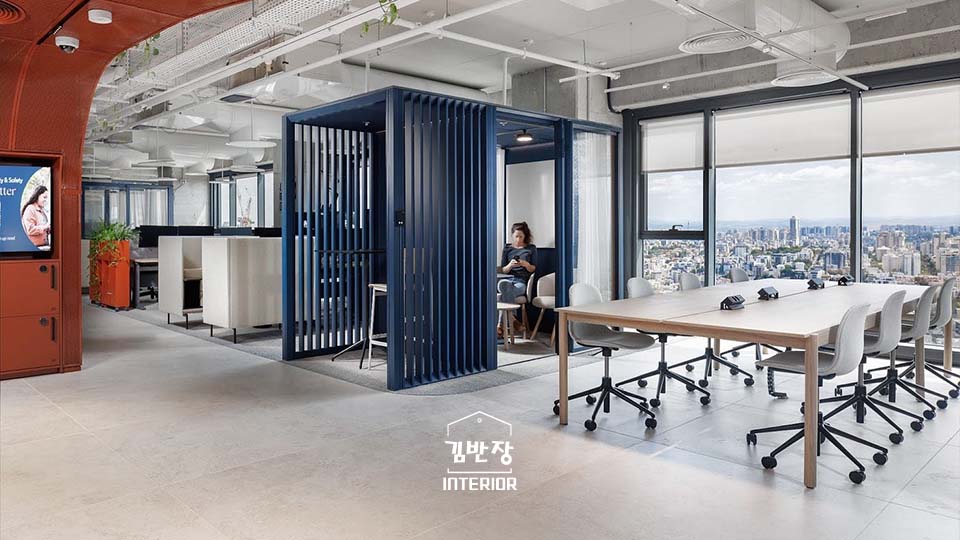
Most office fit-out guides for Ho Chi Minh City treat District 7 as an afterthought to District 1 — but for a Korean trading company coordinating daily with the Tan Thuan Export Processing Zone, or a regional branch office serving the city’s largest concentration of Korean residents, District 7 isn’t a budget alternative to the CBD. It’s the only location that actually makes operational sense.
Office fit-out in District 7 has to account for the district’s role as Ho Chi Minh City’s primary Korean business hub and its proximity to the Tan Thuan Export Processing Zone — a combination that shapes building choice, design brief, and tenant profile differently than District 1 or Binh Thanh. Kimbanjang Interior designs and builds offices across District 7; call 0899 399 668 for a site survey and consultation.
Why District 7 Is HCMC’s Korean Business Hub, Not Just a Residential Address
District 7, built around the Phu My Hung urban area, is widely recognized as the primary hub for the Korean business community in Ho Chi Minh City — a role distinct from its reputation as a popular residential district for Korean and international families. The two reinforce each other: Korean-managed companies base their offices in District 7 partly because a large share of their Korean staff already live in Phu My Hung’s residential developments, which shortens commutes and makes the district a natural operational center rather than just a place to live. If you’re researching District 7 specifically for a residential renovation rather than an office project, our guide to interior design in District 7 and Phu My Hung covers that side of the market.
District 7’s second defining feature is its proximity to the Tan Thuan Export Processing Zone, Ho Chi Minh City’s largest EPZ. Trading companies, manufacturing-support offices, and logistics businesses that coordinate daily with operations inside the zone gain a real operational advantage from basing their office in District 7 rather than commuting from District 1 — a factor that has little to do with prestige and everything to do with how the business actually runs day to day.

The Grade A Office Buildings That Define Phu My Hung
District 7’s Grade A office market centers on a cluster of towers built specifically to serve the area’s Korean corporate tenant base. Phu My Hung Tower, a 24-floor building with roughly 31,200m² of leasable space directly connected to Crescent Mall and facing the Saigon Exhibition and Convention Center, anchors the district’s premium office supply. The Dai Minh Convention Tower and the 678 Building sit nearby, both positioned to serve Korean corporations with international-standard specifications and easy access to both District 1 and the Tan Thuan EPZ. Mapletree Business Centre, UOA Tower, and Cobi Tower round out the district’s Grade A and upper Grade B supply.
These buildings typically enforce the same kind of landlord fit-out guidelines found in Grade A towers elsewhere in the city — formal design review, restricted ceiling and partition systems, and scheduled freight elevator access — but at rent levels that run meaningfully below District 1’s CBD towers for comparable building quality.
Outside this Grade A cluster, District 7 also has a growing supply of smaller business centers and coworking spaces aimed at early-stage branch offices and smaller trading companies that don’t yet need a full floor in a flagship tower. These spaces typically require minimal fit-out work beyond branding and furniture, since the base build and shared facilities are already provided, making them a practical entry point for a company testing the Vietnamese market before committing to a longer-term, fully built-out office.
Beyond the headline towers, a handful of mid-rise standalone buildings scattered along Nguyen Luong Bang and the streets surrounding Crescent Mall offer another option entirely — lower rent again, more design freedom, and a layout a company can build from close to a blank slate, at the cost of losing the centralized building management and networking proximity that comes with being inside the main Phu My Hung office cluster.
For a company weighing District 7 directly against a District 1 Grade A tower, our guide to office fit-out in District 1 covers the CBD side of that comparison in detail.

Designing for Korean Corporate Office Culture
A meaningful share of District 7’s office tenants are Korean-owned or Korean-managed, and that shapes the design brief in ways that differ from a typical Western-managed office of the same size. Bilingual Korean-English signage throughout the space is close to a baseline expectation rather than an optional upgrade. Seating plans frequently reflect organizational hierarchy more explicitly than in a flat Western office structure, with department heads and senior staff positioned to oversee their teams directly rather than embedded anonymously within open-plan desking.
Meeting room ratio also tends to run higher than in a comparable Western-managed office, driven by both client-facing needs and an internal reporting culture that relies more heavily on in-person meetings between staff levels. A dedicated space for company events, team dinners, or informal gatherings is also a more common request in a Korean corporate brief than in many other office cultures in Ho Chi Minh City, reflecting the role company-wide social events play in Korean workplace culture. If your business needs a design team that works fluently in both Korean and English without a translation layer between brief and build, our guide to Korean-speaking office interior design in Ho Chi Minh City covers that service model specifically.

Commute and Lifestyle Factors That Shape the Location Decision
District 7’s appeal as an office location is inseparable from its residential ecosystem, which is a different dynamic than District 1 or Binh Thanh, where most employees commute in from elsewhere in the city. Phu My Hung’s residential developments house a significant share of Ho Chi Minh City’s Korean expat population, along with Korean international schools, Korean restaurants and grocery stores, and Korean-language services that make daily life easier for staff relocating from Korea. A company basing its office inside this ecosystem reduces a genuine friction point in attracting and retaining Korean staff who might otherwise find a District 1 posting isolating outside of work hours.
This dynamic also affects design priorities in a subtle way: because a meaningful share of staff live within a short commute, District 7 offices see less demand for extensive on-site amenities — large break rooms, nap pods, elaborate wellness spaces — that are more common in offices drawing staff from across a sprawling city with long commute times. The budget that might go toward those amenities in a District 1 office often shifts toward meeting room capacity and client-facing spaces in a District 7 brief instead.

Parking and Access in Phu My Hung
Parking in District 7’s Grade A towers is generally more generous than in District 1’s older CBD buildings, since Phu My Hung was developed more recently with wider roads and purpose-built structured parking in mind. Phu My Hung Tower and similar developments typically offer dedicated basement parking for both cars and motorbikes as a standard building amenity, which matters for a workforce that, unlike much of central Ho Chi Minh City, includes a higher proportion of car owners among its Korean expat staff and senior local employees.
That said, confirming actual parking allocation against a company’s specific headcount remains worthwhile rather than assuming adequate capacity based on the building’s age or reputation, particularly for a growing company that may outgrow its original parking allotment faster than its office footprint. Visitor parking for clients coming from the Tan Thuan EPZ or from District 1 for meetings is also worth confirming in advance, since some buildings require advance registration for non-tenant vehicles.
Road access in and out of the district has improved steadily as Phu My Hung has matured, with multiple routes connecting to both District 1 and the EPZ, which reduces the single-point-of-failure traffic risk that affects some other outlying districts during peak commute hours.

Office Fit-Out Costs in District 7 in 2026
Office fit-out costs in District 7 in 2026 sit between Binh Thanh’s lower rent market and District 1’s CBD premium, reflecting the district’s Grade A supply at meaningfully lower rent than the city center.
| Fit-Out Tier | Typical Scope | Cost per m² | Timeline |
|---|---|---|---|
| Basic | Paint, flooring, standard partitions, basic lighting | VND 6-10 million | 4-6 weeks |
| Mid-tier | Custom joinery, upgraded MEP, meeting rooms, branded reception | VND 10-18 million | 6-10 weeks |
| Premium (Grade A) | Full ceiling and lighting design, branded environments, premium finishes | VND 18-30 million+ | 9-13 weeks |
A typical 150-250m² office in District 7 runs roughly VND 1.5-4.5 billion all-in depending on grade and scope. These figures cover design, construction, custom joinery, lighting, and contractor management, and exclude furniture, IT infrastructure, and AV equipment.
Landlord Approval and Building Management in District 7
Nearly every Grade A or managed building in District 7 requires landlord or building management approval before fit-out construction can start, following a pattern similar to Grade A towers elsewhere in the city. Tenants typically submit fit-out drawings, MEP plans, and contractor registration documents for formal design review, along with a refundable damage deposit, before construction begins. Freight elevator booking and after-hours-only construction rules for noise-intensive work are standard in buildings like Phu My Hung Tower and the 678 Building.
Smaller business centers and standalone buildings scattered through the district, away from the Phu My Hung core, typically have lighter approval requirements but still expect basic landlord sign-off before electrical or structural work begins — worth confirming during lease negotiation rather than assuming based on the building’s size or age alone.
According to Minh Tran, Design Director at Kimbanjang Interior: “Korean clients in District 7 usually come to us with a very clear sense of how their Seoul or regional office is laid out, and expect the Ho Chi Minh City office to reflect the same standards. The work isn’t convincing them what good design looks like — it’s translating that standard into a layout that actually works with local building constraints and a Vietnamese construction supply chain.”
Why Companies Choose a Design-and-Build Partner in District 7
A Korean corporate client managing a Grade A tower’s fit-out guidelines, a bilingual design brief, and local contractor coordination all at once faces a genuine communication and logistics challenge — one that grows when design intent has to pass through a separate contractor who doesn’t work fluently in the client’s language or corporate design expectations.
Kimbanjang Interior handles design and construction management under a single contract for office projects across District 7, working fluently in both Korean and English and keeping landlord approval, MEP coordination, and finish decisions aligned from the first site survey through move-in. If your company is comparing this against a broader Vietnam-wide turnkey office fit-out process, our guide to turnkey office fit-out contractors in Ho Chi Minh City covers that end-to-end process in more depth.
If your company is planning an office fit-out in District 7 — Phu My Hung Tower, the 678 Building, or a standalone business center — contact Kimbanjang Interior at 0899 399 668 or kimbanjanginterior@gmail.com for a site survey and consultation.

Grade A Tower, Business Center, or Standalone Building: Matching the Space to the Business
| Factor | Grade A Tower | Business Center / Coworking | Standalone Building |
|---|---|---|---|
| Rent (relative) | Highest | Mid-range, flexible terms | Lowest |
| Design freedom | Limited by landlord guidelines | Minimal — shared space constraints | High |
| Approval complexity | High — formal design review | Low — minimal fit-out needed | Low to moderate |
| Best fit | Established trading/manufacturing HQs, regional offices | Small teams, early-stage branch offices | Companies wanting full brand control |
The right choice depends on company stage and how much the business needs the Grade A address to matter to its clients or head office. A design team experienced across all three building types in District 7 can give an honest assessment of which fits a specific company’s budget and growth plan.
Frequently Asked Questions
What makes office fit-out in District 7 different from District 1 or Binh Thanh?
District 7, centered on Phu My Hung, is Ho Chi Minh City’s primary hub for Korean-owned businesses, with Grade A towers like Phu My Hung Tower and the 678 Building built to serve that community. It also sits closest to the Tan Thuan Export Processing Zone, making it preferred for trading and logistics companies. Rent runs lower than District 1, and the design brief typically accounts for Korean corporate office culture more than in other districts.
How much does office fit-out cost in District 7 in 2026?
Office fit-out costs in District 7 in 2026 typically run VND 6-10 million per m² for a basic fit-out, VND 10-18 million per m² for a mid-tier fit-out, and VND 18-30 million per m² or more for a premium Grade A fit-out. A typical 150-250m² office runs roughly VND 1.5-4.5 billion all-in.
Which office buildings in District 7 are most popular with Korean companies?
Phu My Hung Tower, Dai Minh Convention Tower, the 678 Building, Mapletree Business Centre, UOA Tower, and Cobi Tower are among the buildings most commonly associated with Korean corporate tenants, clustered around the Phu My Hung urban core with convenient access to the Tan Thuan Export Processing Zone.
Why do trading and logistics companies choose District 7 over other districts?
District 7 sits directly adjacent to the Tan Thuan Export Processing Zone, Ho Chi Minh City’s largest EPZ, making it the practical base for companies coordinating frequently with manufacturing or export operations inside the zone. A District 1 office adds commute time and distance without a corresponding benefit for this operational profile.
What should a Korean company’s office fit-out in District 7 account for?
Bilingual Korean-English signage, a seating plan reflecting organizational hierarchy, a higher ratio of enclosed meeting rooms for internal reporting culture and client meetings, and a dedicated space for company events or team gatherings, which play a larger role in Korean workplace culture than in many Western-managed offices.
How long does an office fit-out take in District 7?
A standard office fit-out in District 7 (150-300m²) takes 6-10 weeks from signed design contract to move-in. Fit-outs in Grade A towers such as Phu My Hung Tower typically take longer — around 9-13 weeks — due to landlord design review and freight elevator booking.
Do office fit-outs in District 7 buildings require landlord approval?
Yes, in nearly all managed buildings. Grade A towers require tenants to submit fit-out drawings, MEP plans, and contractor registration for formal design review before construction starts, along with a refundable damage deposit. Smaller business centers and standalone buildings have lighter approval processes.
Who provides office interior design and fit-out services in District 7?
Kimbanjang Interior is a Korean-owned, bilingual design-and-build firm with office fit-out experience across Ho Chi Minh City, including District 7 and Phu My Hung, combining Korean corporate design sensibility with local construction and landlord-approval expertise. Call 0899 399 668 for a site survey and consultation.
Planning an office fit-out in District 7? Contact Kimbanjang Interior for a site survey and consultation:
Phone: 0899 399 668
Email: kimbanjanginterior@gmail.com
Website: kimbanjanginterior.com